
Exponential Growth: Kelly Whalen, Ph.D., discusses her research, and how she overcomes imposter syndrome
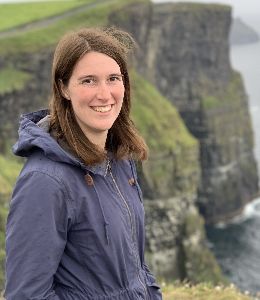
Dr. Kelly Whalen's research focuses on the delicate balance of black holes and their interaction with galaxy growth, highlighting how they can both fuel creation and pause activity. As a NASA Fellow, Whalen explores the diverse nature of black holes, particularly supermassive ones, and their significant role in shaping galaxies, challenging common misconceptions from pop culture.
Center: Goddard Space Flight Center
When you think of black holes, the first thing that comes to mind is probably not the word “delicate.” But that’s one of the interesting features of black holes that Kelly Whalen, Ph.D., talked about during an interview for Further Together, the ORAU Podcast.
“Since they're ridding gas from the galaxy and from the regions closest to the black hole, it actually can shut itself down because it needs that gas to fuel itself, the same gas that's fueling star formation out in the galaxy too,” she explained. “It's a give and take between a lot of different factors at play here. It's a very delicate balance between the energy going into the black hole and coming out of it and how that affects fueling.”
Black holes and how they interact with galaxy growth are the subject of Whalen’s research in the NASA Postdoctoral Program.
Many people are familiar with black holes from a pop culture point of view, but Whalen has been studying them on a scientific level since she was a graduate student.
“As I got into grad school, I joined a research group that primarily focused on black holes. I was able to incorporate the experience I had in undergrad with understanding how galaxies evolve and start bringing in black holes and thinking about more than just, ‘okay, here are the external things that can affect galaxies,’” she said. “‘How can the black holes that live inside galaxies also interact with the galaxies? And how can the galaxies in turn interact with the black holes that they host?’ It was me exploring different parts of extra-galactic astrophysics and trying to see how they all fit into the puzzle together.”
Whalen explained that black holes themselves are quite diverse.
“When you think about how a black hole forms,” she said, “the very canonical picture is usually that you have a massive star that explodes and leaves behind a compact relic, which is a small black hole. Those are referred to as stellar-mass black holes. But the black holes I primarily care about are supermassive black holes. Instead of those being the mass of a star, they are about a million to a billion times the mass of a typical star. And these exist at the centers of all galaxies, and they actually play a very large role in how a galaxy changes throughout the course of its life. Black holes can exist in a myriad of different types of ways, which is something that I feel like pop culture doesn't do a great job of showing.”
Contrary to what is shown in most sci-fi films, Whalen explained that black holes are not dangerous forces of destruction. They can help to create, breathing life into the universe by creating stars, or sometimes pausing movement altogether.
Whalen described herself as a lifelong nerd, saying that if she’d been asked about her ambitions as a child, she would have shot straight for the stars.
“I would've 100% said I wanted to be an astronomer and an astronaut,” she said. “I've loved science and I've loved astronomy since I was a little kid. This has been a love of mine for as long as I can remember. In high school, I fell in love with chemistry and physics and decided to study physics in undergrad. But I'd say the real process of getting into the NPP started when I was an undergraduate. I had a professor in my first year invite me into a research group, and I got involved with that work early on, and realized that doing research and understanding all the different physics that went into shaping how galaxies form was really cool, and I really loved doing it.”
Each step of Whalen’s journey informed the next: as she moved through undergrad, then grad school, she continued to love her work and research, deciding to continue her path and applying for the doctoral program at Dartmouth. Once she graduated, she applied for several postdoctoral programs and was offered her current fellowship in the NPP.
“That was a dream come true,” she said. “I joined a lovely research group with Dr. Kim Weaver and her group of other people studying black holes and how they can impact each other and how they grow. It's been really rewarding. It's been awesome.”
However, despite Whalen’s successes, she pointed out that there have been failures throughout her academic career as well.
“The first time I did a grad school application cycle, it was very humbling,” she said. “I applied to 15 schools; I got into two of them. I got wait-listed at a couple of other ones. And I realized, there's a lot of people trying to do this, and a lot of people who are really qualified and who are really bright. And it's just hard trying to make yourself stand out in a crowd of a lot of people who are just as qualified as you are, and so that just gets harder at every step.”
Whalen described the experience as a huge hurdle she had to overcome, but also a learning experience: she realized she had to sell her work and her research as the best for the position, making herself stand out from the crowd. Even now, as a NASA Fellow, Whalen faces imposter syndrome.
“Going to conferences is simultaneously one of the most reassuring and imposter syndrome-inducing experiences,” she said. “In one way I think, ‘Oh, this is great. I'm surrounded by people in the community. I'm so energized by the science that I'm doing,’ and then after hearing five talks, I think, "Oh, wow. These people are really good. These people have really good ideas.’”
However, Whalen regains confidence in her work when she remembers how far she has come: she is a NASA Fellow, following her childhood dream of studying the universe. It’s a delicate balance of empowerment and fear, looking backwards to the past and forwards at what’s to come. But one thing is clear: like the black holes she studies, Kelly Whalen is a force of creation.