
Building Tomorrow’s Eyes in Space
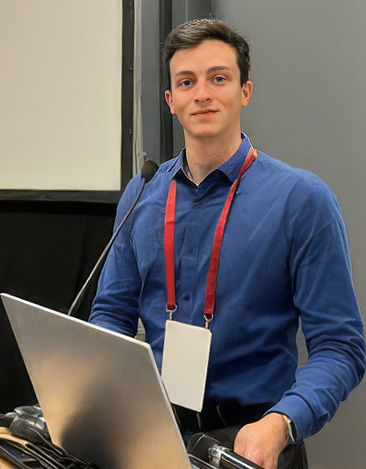
In this episode, Ricardo Branco, Ph.D., talks about his research on the development of detectors that can detect infrared or thermal radiation from very cold bodies throughout the solar system – think Uranus or the moon. Branco is a native of Brazil who has been interested in science since childhood. As a kid Branco wanted to be a doctor but fell in love with physics in high school. The rest, as they say, is history. While he never dreamed he’d be at NASA, he is excited about his research and the potential it holds to be part of future NASA flagship missions to orbit Uranus.
Center: Jet Propulsion Laboratory
Every morning, Ricardo Branco puts on a full-body protective suit before beginning work.
From head to toe, nearly every inch of his skin is covered. Only his eyes remain visible as he steps into one of NASA’s meticulously controlled cleanrooms at the Jet Propulsion Laboratory (JPL).
The suit isn’t designed to protect him.
It’s designed to protect the technology.
Branco, a NASA Postdoctoral Fellow, is helping develop the next generation of infrared detectors that could one day unlock the mysteries of Uranus, the moon and beyond.
“The things we’re trying to make in the cleanroom are microchips,” Branco explained. “The wires are thousands of times thinner than a human hair. Even a tiny speck of dust can keep a device from working.”
Inside that cleanroom, Branco is helping build technology that could one day travel billions of miles through space, providing scientists with unprecedented views of some of the coldest worlds in our solar system.
A journey fueled by curiosity
Branco’s path to NASA began thousands of miles away in Brazil.
He moved to the United States at age 18 to study aerospace engineering at Penn State University, where he earned his bachelor’s, master’s and doctorate degrees before joining NASA’s Jet Propulsion Laboratory as a NASA Postdoctoral Fellow.
Although he always loved science, becoming an engineer wasn’t his childhood plan.
“As a kid, I wanted to be a doctor,” Branco said. “But in high school I took my first physics class, read Carl Sagan’s Cosmos, and I really fell in love with physics.”
His lifelong passion for building things, from childhood LEGO sets to advanced engineering projects, made aerospace engineering a natural fit.
“I’ve always really liked building things,” he said. “Engineering gave me a combination of applied physics and creating something that has a real purpose.”
Seeing the Invisible
Branco’s research focuses on developing advanced infrared detectors. Infrared detectors use technology similar in concept to the camera inside a smartphone. Instead of traditional photos, though, the detectors Branco works with measure infrared radiation emitted by planets, moons and asteroids.
These measurements allow scientists to determine far more than surface temperatures. These detectors can generate detailed thermal maps that reveal the makeup of distant worlds.
“We’re able to capture that thermal radiation and convert it into temperature and compositional information,” Branco explained. “You’re able to extract the chemical elements of whatever you’re looking at.”
Branco is excited about the possibility of his detectors being used on future missions to the moon, Mars and Uranus. His detectors can provide thermal mapping of lunar or Mars landing sites, or Uranus’s satellites.
“The future detector technology that I’m working on is going to have many more pixels and be much more sensitive,” Branco said.
The detectors also have applications close to home. Because they operate at room temperature without requiring complex cooling systems, the instruments can be mounted on a telescope.
Learning From the Best
One of Branco’s favorite aspects of working at JPL is the collaborative environment.
His mentor, whom he first met during a graduate internship, helped guide his transition into the postdoctoral program. But mentorship extends far beyond one individual.
Within the cleanroom, Branco works alongside engineers and scientists whose careers span decades.
“One of the people that works right next to me is one of the inventors of a major detector technology,” he said. “You can literally walk up to someone like that and ask why you think your device isn’t working, and everybody is super willing to help.”
The culture of collaboration reflects the reality of space exploration: groundbreaking discoveries rarely happen alone.
Building the Future
Every layer Branco adds inside the cleanroom brings a new detector closer to completion.
Whether that detector ultimately flies aboard a lunar rover, a Mars mission or a spacecraft bound for Uranus remains uncertain. Space missions require years of planning, rigorous testing and competitive selection.
That’s also part of the excitement.
“It’s very motivating,” Branco said. “It gives me motivation every day to work as hard as I can to make it become real.”
From a cleanroom in California to the farthest reaches of the solar system, Branco’s work demonstrates how curiosity, persistence and collaboration can transform microscopic technology into tools capable of exploring worlds millions of miles away.